You're getting impressions, but are you making one?
2 billion impressions on social. Here is MIchael's take.
By Visual Narrative
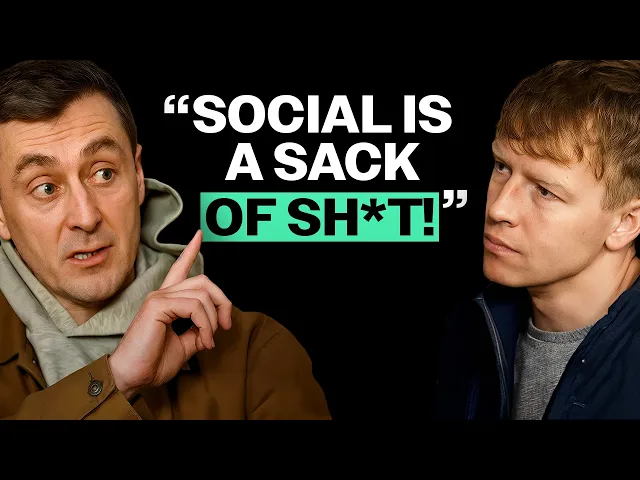
I listened to Michael Corcoran on Callum McDonnell's podcast recently.
He described the current state of social media as a "steaming sack of"... well, you can fill in the blank.
And he's not wrong.
Most brands right now are getting impressions. But they're not making an impression.
There's a massive difference.
I pulled out the takeaways I think matter most for busy B2B marketers. The ones you can actually do something with.
Each section links to the exact moment in the episode if you want to hear Michael explain it himself.
1. Strategy first. Everything else second.
Watch this section: https://youtube.com/watch?v=Rq2HSd93qUE&t=434s
Most brands don't have a social media strategy. They have a posting schedule.
A calendar is not a strategy. Content pillars are not a strategy.
Strategy is finding the gap, the problem, the opportunity your brand can solve. Then working out how social helps you get there.
Without that, you're just filling the feed.
Trends are a trap.
Watch this section: https://youtube.com/watch?v=Rq2HSd93qUE&t=434s
Every brand piles onto the same cultural moment. Taylor Swift gets engaged. Twenty brands stick a blonde wig on their product.
The audience laughs. Gives it a lazy like. Scrolls on.
But who do they remember? The trend. Not you.
Picasso said good artists borrow, great artists steal. Steve Jobs repeated it. But there's a difference between stealing an idea and making it yours versus just photocopying what everyone else is doing and hoping nobody notices.
If you can't prove a trend moved a single brand metric beyond impressions, what exactly did it achieve?
You became the platform's best unpaid employee. And you paid for the privilege.
There are four ways to win on social. Most brands use one.
Watch this section: https://youtube.com/watch?v=Rq2HSd93qUE&t=890s
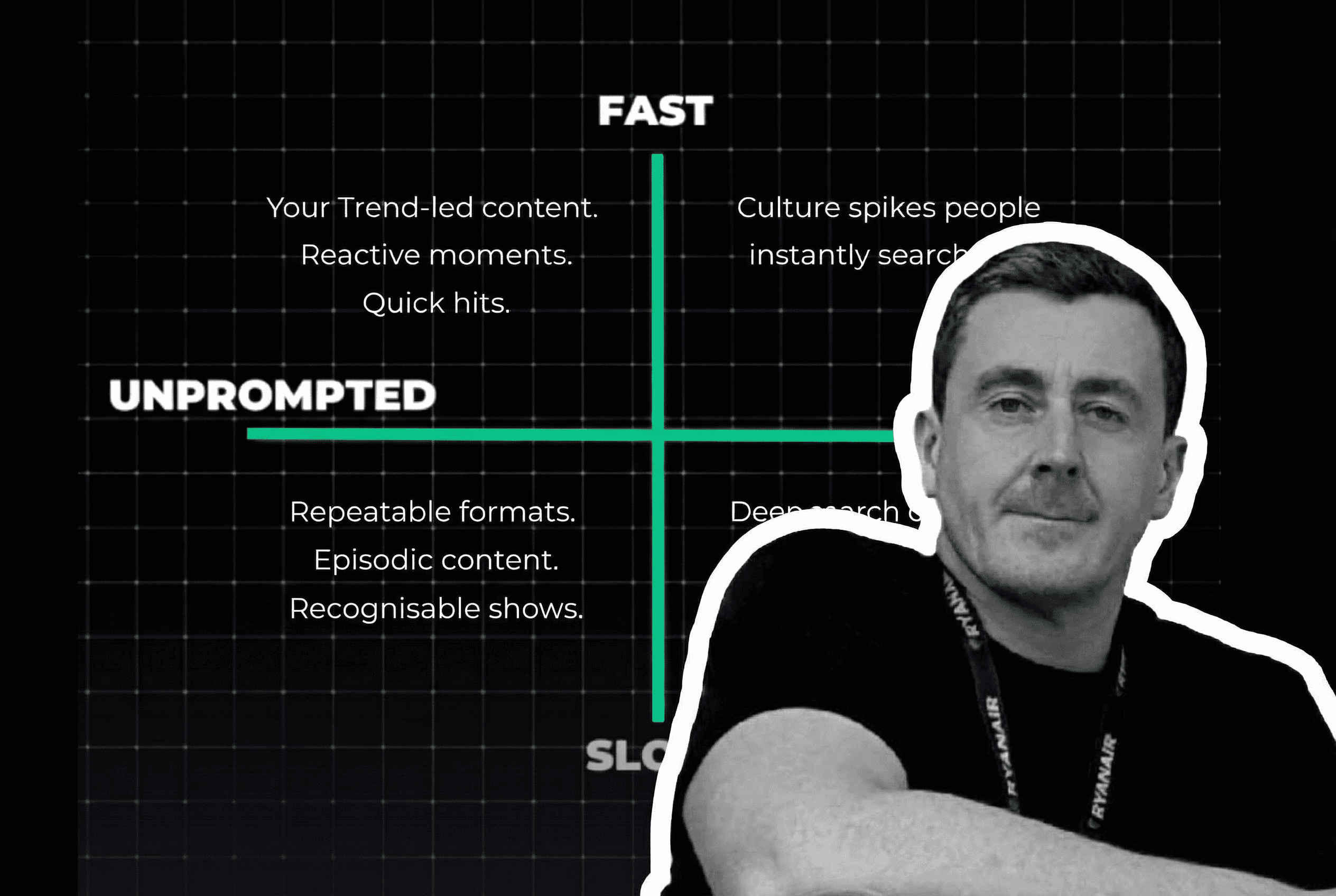
Michael breaks it into a matrix. Fast vs slow. Prompted vs unprompted.
Fast unprompted: Trends, reactive content, comment sections. Where everyone is camped right now.
Slow unprompted: Repeatable formats, episodic shows, recurring characters. Content people recognise before they even read your name.
Slow prompted: Search. People are using TikTok, Instagram, and YouTube like Google now. If you're not there, someone else is.
Fast prompted: Cultural moments people actively search for. Something gets censored on live TV. Everyone goes looking for the clip. Are you there?
You don't need to do all four. You need to pick the quadrant that matches your actual problem, your time, and your resources.
That's strategy. Not tactics.
Make people feel something. Or don't bother.
Watch this section: https://youtube.com/watch?v=Rq2HSd93qUE&t=1489s
This is the bit I keep banging on about, and Michael nails it.
You have to evoke emotion. You have to create some form of tension. You have to make somebody feel something.
And then there have to be cues that connect it back to your brand.
Not product shots rammed down their throat. Not a logo slapped on a trending meme. Actual brand cues that people start to associate with you over time.
No cues, no memory. No memory, no brand.
B2B doesn't get a pass on this. B2B is still B2P. You're still selling to a person. And that person still has feelings, still laughs, still gets bored by the same corporate wallpaper as everyone else.
If your content doesn't make someone feel something, it's just noise in an already noisy room.
Brands doing this well right now:
Currys are brilliant at weaving product and their in-store specialists into fast cultural content. They react to moments, but they always connect it back to what they actually sell. Their TikTok is worth studying.
Candy Kittens built CKTV, a recurring office-skit format with recognisable characters, distinct visual cues, and Jamie Laing as a familiar anchor. Every time it appears in your feed, you know exactly what it is before you've read a word. Check their TikTok too.
Confused.com took one of the most boring topics on earth (insurance) and created repeatable TLDR formats that exaggerate how tough it is to be an adult, then make the boring stuff digestible.
Gymshark have been native to social from day one, but what's interesting now is how they're evolving from pure community content into proper brand storytelling as they compete with the big players. Their TikTok is a masterclass in knowing your audience.
The common thread? They all make you feel something. And they all have cues you'd recognise even with the logo removed.
Start with the idea. Not the format.
Watch this section: https://youtube.com/watch?v=Rq2HSd93qUE&t=2877s
Most teams start with "let's make a video."
Wrong starting point.
Start with the idea. What do you want people to feel, think, or do?
Then build an ecosystem around it. The video. The copy. The comment section. The creator cameos. The distribution.
A24's Marty Supreme campaign is a masterclass in this. One idea: Dream Big. Then a fake Zoom pitch, a ping pong van, Serena Williams in a branded jacket, everything drenched in orange. All different executions. All building the same cues.
Most brands would've made a trailer and crossed their fingers.
Distribution is the forgotten half.
Watch this section: https://youtube.com/watch?v=Rq2HSd93qUE&t=2744s
Teams spend weeks crafting content. Getting approvals. Optimising the hook.
Then they hit publish and go home.
The smartest creators and podcasts treat distribution as its own creative discipline. Clipper accounts. Aggregator accounts. Creator cameos. Seeding content into communities.
Different cuts of the same idea, travelling through different corners of the internet.
Content creation is half the job. Getting it seen is the other half. And most brands have completely neglected the second half.
You're building on rented land.
Watch this section: https://youtube.com/watch?v=Rq2HSd93qUE&t=339s
TikTok nearly got switched off in the US. X has been... well, X.
You don't own your audience on social media. The platform does.
If you're not building touchpoints you actually control, your email list, your website, your direct relationships, you're building a house on someone else's land.
It's why this newsletter exists. And why yours should too.
Test. Learn. Repeat.
Watch this section: https://youtube.com/watch?v=Rq2HSd93qUE&t=4195s
Let the audience decide.
Build content with enough degrees of change so you can learn from each round. If it works, brilliant. If it doesn't, change something and go again.
You won't crack the code on day one. But if you build a proper feedback loop, thinking, doing, learning, you get closer every time.
That's not a new idea. That's a timeless one. It's also the one most brands skip because they're too busy chasing the next trend.
So where does this leave you?
If you're reading this thinking "this all sounds great, but I barely have time to post three times a week," I get it. Genuinely.
You know social matters. You can see the opportunity. But between the day job, the approvals, and the six other hats you're wearing, doing it properly feels impossible.
It's exactly why we built our social media growth packages. Not to take over your voice or churn out generic content. To give you the strategic support and extra hands to actually do the things this episode talks about. Strategy. Testing. Distribution. Measuring what matters.
If any of this resonated, drop me a message. No pitch. Just a chat.
And if you want the full episode, it's worth your time:
